Pietra Dura is a term often found in auction catalogues, but what is pietra dura, and where does it originate from.
Pietra Dura, meaning ‘hard stone’ in Italian, is a method of creating images by using the technique of stone cutting. Often semi precious stones such as jasper, lapis lazuli and marble, but sometime also precious stones, are precisely cut with interlocking sections and glued side by side within a frame to create colourful and intricate images.
The decorative art first appears in its recognisable form in 16thC Rome, but is thought to have much earlier origins in Ancient Rome where a similar technique was used to embellish floors and walls using mother of pearl, marble and in some cases glass.
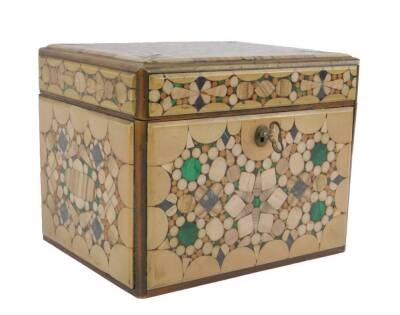
Pietra Dura was especially popular in Florence where Ferdinano I de’Medici in 1588 established the Galleria di Lavori to allow artisans the space to further develop the skill. The fashionable decorative technique would become a world wide phenomenon; a notable example of its use in the early 17thC is at the Taj Mahal in Agra, where the walls are adorned with inlaid floral motifs in semi precious stones, as well as the high altar in the Cathedral of the Assumption of the Virgin Mary in Dubrovnik.
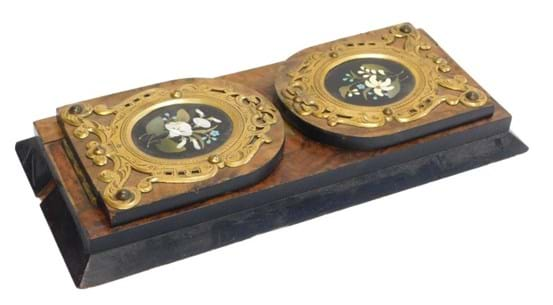
Floor panels, tabletops, as well as smaller decorative items such as trinket boxes and jewellery became adorned with this decorative technique over the coming centuries. Examples sold by Golding Young in recent years include a pair of 18thC panels depicting figures in landscapes that sold at the Grantham Auction Rooms in December for £240, and a Victorian burr walnut and ebonised bookslide inlaid with pietra dura floral panels which sold for £65 at the Bourne Auction Rooms in November. A further notable example of a 19thC Bohemian pietra dura specimen box, possibly Karlsbad, realised £800 at our Lincoln Saleroom in 2019.